Where to Sell Magic: The Gathering Cards: Sort, Value, Sell
By syedladen ·
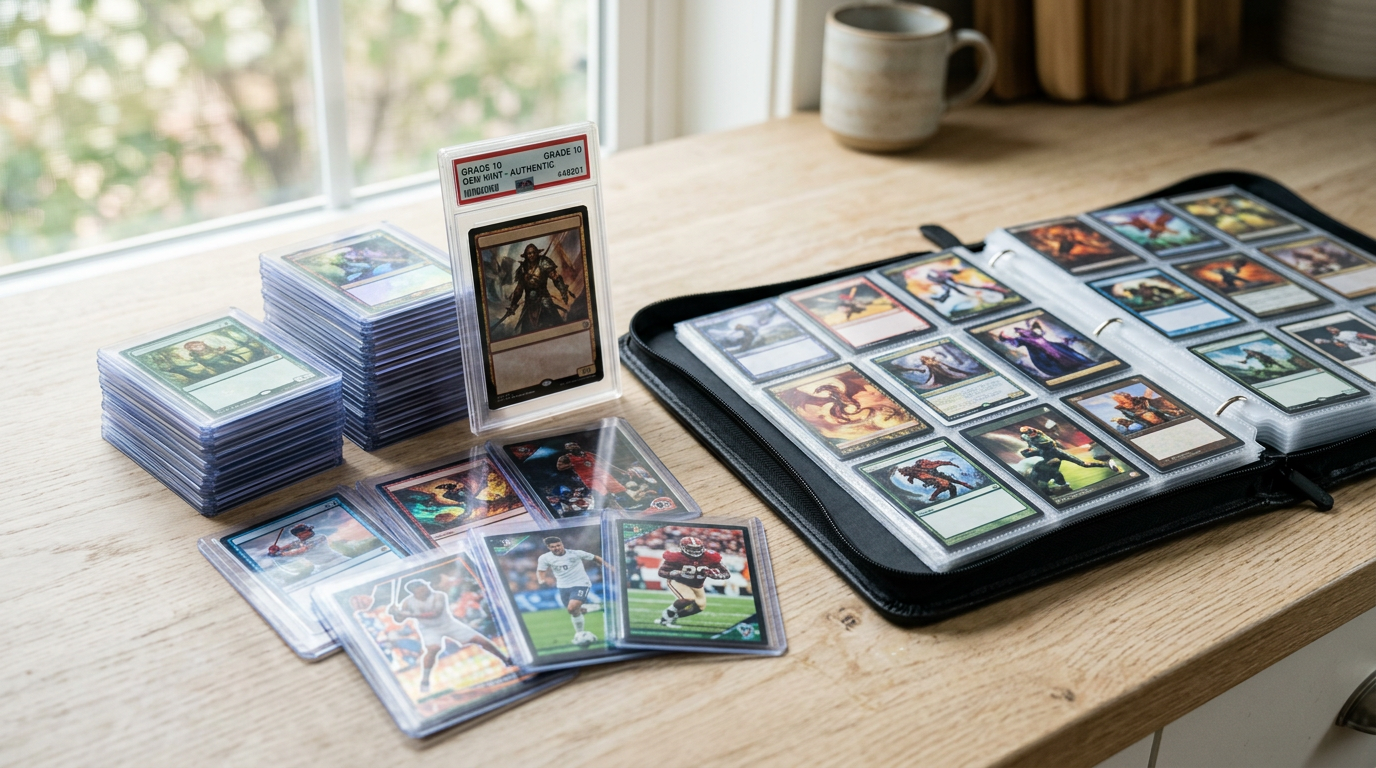
The best place to sell Magic: The Gathering cards depends on what you actually have: a buyer that takes the whole collection in one visit is fastest for mixed boxes, while individual high-demand singles can return more if you have the patience to list them one by one. Most people end up doing a mix, so the real work is sorting your cards into the piles that deserve different routes.
This guide walks through how to sort a collection, which cards to pull first, how language, printing, and condition change value, how the main selling options compare, and what to do with sealed product. If you just want to know what a stack is worth right now, you can get a free cash quote and skip ahead.
Match your collection to the right selling route
Before comparing platforms, decide which of these describes you. It narrows the decision quickly.
- A few boxes of mixed cards from years ago: Sort out the obvious valuable cards, then sell the rest to a buyer who will take large lots. Listing thousands of low-value cards individually rarely pays for the time.
- A focused collection of high-demand singles or older cards: Worth checking individually. A buyer who evaluates in person can be good here, and you can compare that against online sold listings.
- Graded cards: These are priced by grade and certification, not by card name alone. Keep them in their slabs and get quotes from buyers who specifically handle graded cards.
- Sealed boosters, boxes, or decks: Handle these differently from singles. More on that below.
- Need cash soon: A walk-in or same-day buyer beats waiting on marketplace sales, shipping, and payout holds.
Before you sort: set up and protect what you have
A little prep prevents the most common value-killing mistakes.
- Get a clear surface and good light. You are going to be checking edges, surfaces, and foil patterns.
- Gather penny sleeves, top loaders, and a few empty boxes. Anything that looks valuable goes into a sleeve right away.
- Do not clean cards. Wiping, rubbing, or using any liquid damages surfaces and usually makes a card look worse to a buyer.
- Do not peel cards apart if they are stuck. Set those aside and ask a buyer; forcing them can tear the surface.
- Keep sets together where you can. If cards were in a binder or a labeled box, that context helps when you search for printings.
How to sort a bulk collection step by step
The goal is not to price every card. It is to separate the small number of cards that move the total from the large number that do not. A quick first pass in this order usually does the job.
Pull rares and mythic rares first
Rares and mythics are marked by the color of the set symbol: gold for rare, orange-red for mythic. Most rares are not valuable, but nearly all of the high-value modern cards sit in this group. Put them in a separate stack, then check each against a current market reference and recent sold listings, not just asking prices. Look at demand drivers: cards that see play in Commander, Modern, Legacy, or Pioneer tend to hold value better than cards that only made sense in one rotated Standard season.
Separate every foil
Foils carry a different price than their non-foil versions, sometimes a small difference and sometimes a huge one, especially in older sets. Older foils can also curl, cloud, or show surface wear more easily, so condition matters even more. Check foils in a separate pass, and do not assume that a foil commons pile is worthless; older foils and special foil treatments can be surprising. Keep foils flat and sleeved.
Identify Reserved List cards
The Reserved List is a public promise by Wizards of the Coast never to reprint certain older cards. Because supply cannot increase through reprints, these cards tend to hold value better than comparable non-reserved cards. Look up the current list before you sell, and check any card from older sets, including cards from the very earliest expansions. Do not guess: some old cards are on the list and plenty of others are not, which makes a big difference in value.
Check older frames and early sets
Cards printed before the modern card frame was introduced with Eighth Edition have an older look: different text placement and a different layout. Early black-bordered sets, white-bordered sets, and early expansions can be valuable, but only when the printing and condition line up. Also check the border. Collectors’ Edition cards have a square corner and a gold back border and are not tournament legal, and they are priced separately from regular printings, so identifying them correctly matters.
Everything else: bulk
What remains is bulk: commons, uncommons, most basic lands, and non-valuable rares. Bulk is usually sold by quantity or weight, and the per-card value is low. For a typical collection, your gain from time spent on bulk is small, so the practical move is to sell it in a lot. Searching for mtg bulk buy options will show you who takes large quantities; you can also ask us for a quote on the full collection so you know what a single-visit sale looks like.
Do not forget the odd extras
Check for promo cards, tokens, oversized cards, Secret Lair releases, borderless and extended-art versions, Commander-exclusive cards, and cards from special sets meant for collectors. These can be easy to overlook in a pile and can be worth a separate look.
Language and printing differences that change value
Two cards with the same name can be priced very differently. Always identify the exact version before you trust a price.
- Set and printing: Check the set symbol and collector number at the bottom of the card. Many cards have been printed a dozen or more times, and value varies widely by printing.
- Frame and art treatment: Showcase, borderless, extended art, retro frame, and full-art versions often trade separately from the standard version.
- Language: English is usually the easiest to sell and the most liquid. Non-English cards are often priced differently. Some languages or special printings can be in demand, but many are noticeably lower than English, and some buyers do not take them at all. Do not assume a foreign card is worth more.
- Special print runs: Cards with unusual language treatments, alternate art, or special promotional stamps can be in demand among collectors.
- Misprints and errors: Real errors exist, but most “misprint” claims are cutting or print variance that does not add value. Only rely on a buyer who can assess it in person.
- Signed or altered cards: Signed cards and artist-altered cards can be valuable to collectors, but they are usually not priced like standard copies and are tournament-illegal when altered in some ways. Mention them up front.
Condition grading: NM, LP, MP, HP
Condition is the second biggest factor after the card itself. Buyers and marketplaces typically use a common scale. Standards vary between buyers, so treat the table as a guide rather than a guarantee.
| Grade | What you usually see | Effect on value |
|---|---|---|
| Near Mint (NM) | Clean surface, sharp corners, minimal or no edge wear, at most a tiny flaw | Baseline; the price most references quote |
| Lightly Played (LP) | Minor edge whitening, small corner wear, light surface scuffs | A modest step down from NM |
| Moderately Played (MP) | Obvious whitening, corner rounding, visible scratches or light creases | A clearly lower price than NM |
| Heavily Played (HP) | Heavy wear, bends, creasing, peeling, or major edge damage | Much lower; often sold for playability only |
| Damaged | Tears, water damage, writing, holes, inking, or major bends | Lowest tier; some buyers decline these |
How to check a card quickly
- Tilt the card under a light and look for scratches and scuffs on the surface.
- Check all four corners for softness or whitening.
- Run your eye along the edges, especially on dark-bordered cards where whitening is most visible.
- Look at the back of the card; wear shows quickly on the dark back border.
- Check for bends by holding the card at eye level. Bent or creased cards drop a grade quickly.
Be honest when you self-grade. Most sellers rate their own cards a notch higher than a buyer will, and being realistic ahead of time avoids surprises at the counter.
Where to sell: options compared
Here is how the main routes differ. Exact fees, payout terms, and buy rates change, so check current terms before you commit.
| Option | Best for | Speed | Trade-offs |
|---|---|---|---|
| Sell Your Gadgets (in-store or mail-in) | Mixed collections, bulk, sealed product, and cash the same day | Fast; inspection and payment on the spot in store | A buyer has to make a margin, so individually listing a rare card yourself may return more if you can wait |
| Local game store | Quick trades, store credit, local tournament staples | Often same day | Buying interest varies by store, and credit offers may be better than cash offers |
| Online marketplaces (such as TCGplayer or eBay) | Individual valuable singles, sellers with time to list | Slow; depends on listing, sale, and shipping | Seller fees, shipping costs, disputes, and the work of photographing and packing each order |
| Online buylists from card retailers | Cards on their current wants list | Medium; ship, then wait for grading and payout | Offers change often, and they may downgrade condition after receipt |
| Social groups and forums | Niche cards, collector-to-collector deals | Varies | Scam risk, payment disputes, and lots of back-and-forth |
| Auction houses and graded-card consignment | Very high-end and graded cards | Slow | Commission, waiting for the auction, and less certainty on final price |
How to pick
If your collection is one or two dozen meaningful cards, list them yourself or use a buylist and compare. If it is hundreds of cards in mixed condition, the hours you spend listing usually cost more than the extra return. A good split: sell the top handful individually and sell the rest, including bulk, to a walk-in buyer. If you want to sell your MTG collection in one visit, that is the simplest way to do it, and you can see how it works on our how it works page.
Selling sealed Magic product
Sealed product is priced as its own category, and it is easy to lose value through small mistakes.
- Keep it factory sealed. Never open a box or pack to “check” it. Opened product is sold as singles, which is a different calculation.
- Know the product type. Draft boosters, set boosters, collector boosters, bundles, Commander decks, prerelease kits, and Secret Lair drops are all different products and are priced differently.
- Condition of the packaging matters. Crushed corners, torn or loose shrink wrap, sun fading, and dents reduce what a buyer will offer.
- Watch for resealing. Older sealed product is a known target for resealing, so serious buyers inspect wrap, seams, and seals. Keep any original receipts or purchase records if you have them.
- Storage matters. Keep sealed product away from heat, humidity, and direct sunlight until you sell.
- Older sealed product can be a big category. Sealed boxes from older sets can be worth far more than the cards you might pull from them, and they reward a proper in-person inspection.
Tell the buyer exactly what you have, including the set name, product type, and language, and get a quote before you travel.
What to bring and what to expect at a walk-in sale
Our process is simple: get a free quote, bring your cards in for a quick inspection, and get paid on the spot. No appointment is needed. You can start with a free quote online or by text, or find the closest store on our locations page. We have walk-in stores in New York, New Jersey, Florida, Texas, Maryland, Arizona, Georgia, and Virginia, and a mail-in option if you are far from a store.
- Bring a valid government photo ID. It is required for every sale.
- Bring the high-value stack sleeved separately from the bulk, with graded cards in their cases.
- Bring sealed product in its original condition.
- Tell us what you know: anything signed, altered, or non-English, and what you think is most valuable.
- Be ready for a decision. You are free to accept or decline the offer.
We buy trading cards across Magic and other games, raw, graded, and sealed. If you also have a Pokémon stack, see our page on how to sell Pokémon cards and collectibles.
Mistakes that cost sellers money
- Pricing from asking prices. Look at what cards actually sold for, not what sellers hope to get.
- Ignoring the printing. The same card name can have versions with very different values.
- Overgrading your own cards. Buyers grade conservatively, and buylists often downgrade.
- Selling the best cards in bulk. Sort first, at least for rares, foils, and old cards.
- Cleaning or repairing cards. It almost always hurts.
- Forgetting fees and shipping. A higher sale price online can shrink once fees, packaging, and time are counted.
- Opening sealed product. It is the one mistake you cannot undo.
Frequently asked questions
What is the fastest way to sell MTG cards for cash?
A walk-in buyer. You bring the cards, they are inspected, and you are paid on the spot, without listing, shipping, or waiting for a buyer. It is the practical route if you want to sell MTG cards for cash in a single visit.
Are my bulk commons and uncommons worth anything?
Individually, very little. In quantity, they have some value, which is why buyers take them in large lots. Do not spend hours on them, but do check for foils, old cards, and special printings mixed in.
Should I sell my whole collection together or split it up?
Splitting usually gets the most value: list or separately quote your best cards, then sell the remainder as a lot. If convenience matters more than squeezing out every bit of return, selling everything together is simpler.
Do buyers take non-English Magic cards?
Some do, and some do not. Non-English cards are commonly priced differently from English versions, and many are noticeably lower. Mention the language when you ask for a quote.
Should I get my cards graded before selling?
Only for cards where the value gap between raw and graded could be meaningful and you are confident they are in top condition. Grading costs money and time, and it only pays off for a small fraction of cards. If you are unsure, ask for a raw quote first.
Can I sell sealed Magic boxes and packs?
Yes. Keep them factory sealed and in the best condition possible, and tell the buyer the set, product type, and language. Sealed product is priced separately from singles, so do not open it.
What do I need to bring to sell my cards in store?
A valid government photo ID is required for every sale. Bring your cards sorted and protected, and get a free quote ahead of time if you want to know what to expect.
Ready to find out what your collection is worth? Get a free cash quote online or by text, or walk into your nearest Sell Your Gadgets store and get paid on the spot.
Hear from a real customer
A real customer on their experience. Working or broken, get a free quote and walk out with cash the same day.
Compare your options
See how selling to us stacks up against other ways to sell, side by side.